Your What is a photoreceptor layer images are ready. What is a photoreceptor layer are a topic that is being searched for and liked by netizens now. You can Download the What is a photoreceptor layer files here. Find and Download all free photos.
If you’re searching for what is a photoreceptor layer images information related to the what is a photoreceptor layer topic, you have visit the right blog. Our website always provides you with suggestions for downloading the maximum quality video and picture content, please kindly hunt and find more informative video content and images that fit your interests.
What Is A Photoreceptor Layer. Photoreceptors are specialized cells for detecting light. Photorecptors This is where the rods and cones are located that convert light into electrical signals. Imaging analysis by spectral-domain optical coherence tomography. Photoreceptors are special cells in the eyes retina that are responsible for converting light into signals that are sent to the brain.
 Sight The Sense Of Vision Medical Anatomy Medical Terminology Study Human Anatomy And Physiology From pinterest.com
To be more specific photoreceptor proteins in the cell absorb photons triggering a change in the cells membrane potential. Pertaining to the retina. Retinal pigment epithelium This is a single layer of cells that provide essential nutrition and waste removal for the photoreceptor cells. Photoreceptors Layer Layer of rods and cones. The central fovea has no rods and foveal region is densely packed with cones 2 00000 cones per square millimeter. Red green and blue.
Photorecptors This is where the rods and cones are located that convert light into electrical signals.
Photoreceptor layer outer nuclear layer an In the rod and cone layer. The structure of photoreceptor terminals is unique in the nervous system as they contain a specialized structure called a ribbon that facilitates the release of the excitatory neurotransmitter glutamate onto second-order retinal neurons bipolar and horizontal cells. Low light level with high sensitivity also known as scot. Photoreceptors are located in the retina which is a light sensitive neural layer of tissue at the back of the eye. Everything else pushed aside Why is there just photoreceptor layers at the central one degree. Almost all parts of the retina are made up of a thin transparent tissue formed by a set of nerve fibers and photoreceptor cells which are specialized cells in charge of converting light into signals that are sent to.
 Source: in.pinterest.com
The photoreceptor layer contains only photosensitive part of rods and cones whereas cell bodies and inner processes of them lies in outer nuclear and outer plexiform layers. The cell bodies of the two latter neuronal cells as well as from amacrine and Müller cells constitute the inner nuclear layer. What is a photoreceptor. Red green and blue. Rhodopsin Phosphorylation Quenching R.
Source: pinterest.com
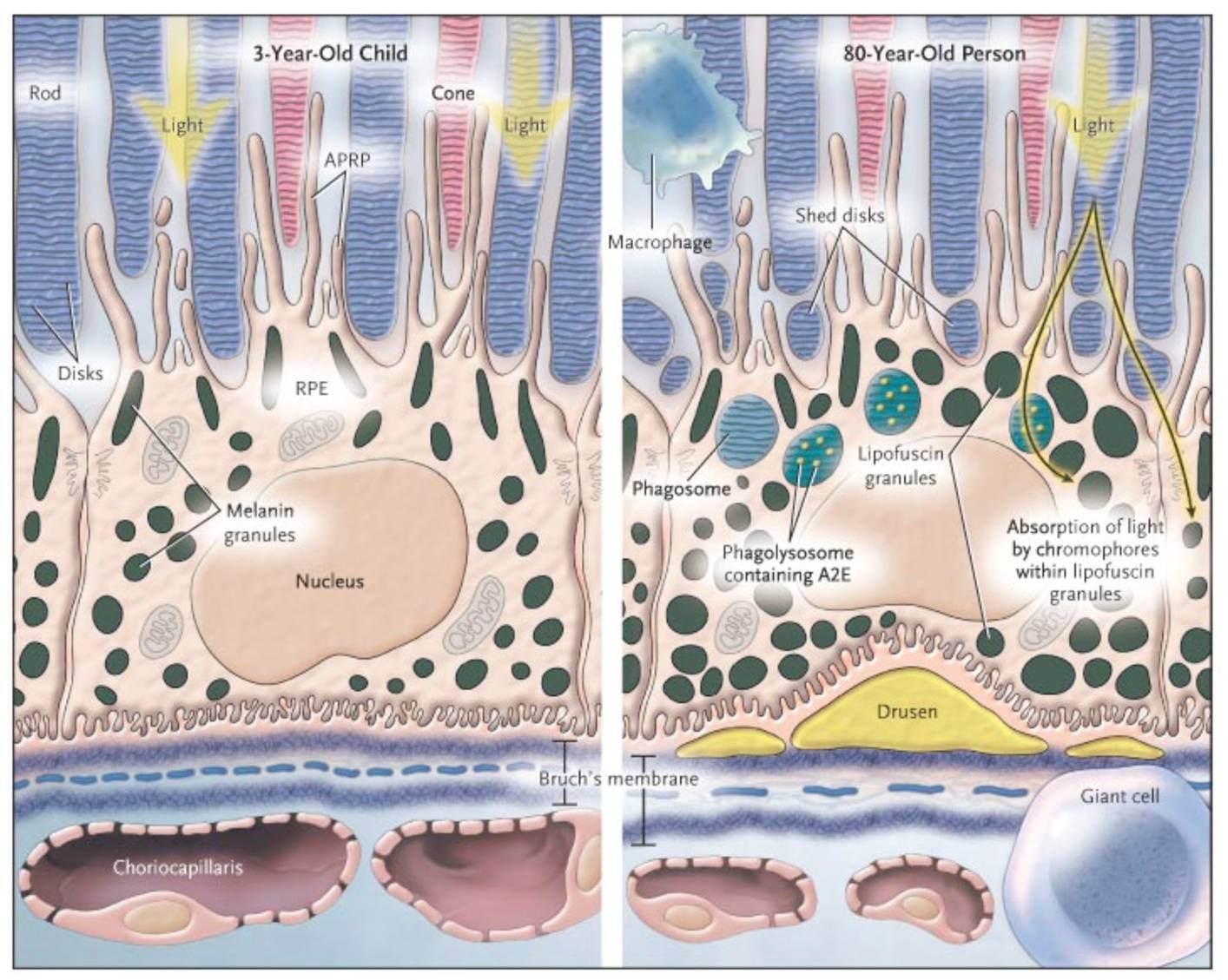
Accumulation of waste can lead to AMD and Stargardt disease. The photoreceptor layer as a prognostic factor for visual acuity in the secondary epiretinal membrane after retinal detachment surgery. The cellular layers of the retina are as follows. Outer-Segment Discs Disc Morphogenesis Outer-Segment Plasma Membrane. Red green and blue.
 Source: pinterest.com
Just layers that include photoreceptors. 7 rows Photoreceptor layer of retina - histological slide. Light-evoked signals are relayed passively down the photoreceptor axon up to 75 µm long to the synaptic terminals in the outer plexiform layer. Low light level with high sensitivity also known as scot. Photoreceptors are specialized cells for detecting light.
 Source: pinterest.com
Structure and function of photoreceptors. Outer-Segment Discs Disc Morphogenesis Outer-Segment Plasma Membrane. To describe changes of the foveal photoreceptor layer using optical coherence tomography OCT in central serous chorioretinopathy CSC and evaluate the correlation with visual acuity VA loss. A photoreceptor cell is a specialized type of neuroepithelial cell found in the retina that is capable of visual phototransduction. Accumulation of waste can lead to AMD and Stargardt disease.
 Source: pinterest.com
The great biological importance of photoreceptors is that they convert light into signals that can stimulate biological processes. Photorecptors This is where the rods and cones are located that convert light into electrical signals. Photoreceptors are image forming cells. The photoreceptor consists of 1 an outer segment filled with stacks of membranes like a stack of poker chips containing the visual pigment molecules such as rhodopsins 2 an inner segment containing mitochondria ribosomes and membranes where opsin molecules are assembled and passed to be part of the outer segment discs 3 a cell body containing the nucleus of the photoreceptor cell and 4 a. Photoreceptor layer outer nuclear layer an In the rod and cone layer.
 Source: cz.pinterest.com
The photoreceptor layer as a prognostic factor for visual acuity in the secondary epiretinal membrane after retinal detachment surgery. The tomographic findings of the detached foveal photoreceptor layer were. Photoreceptors are the cells in the retina that respond to light. Evan Debevec-McKenney Elizabeth Nixon-Shapiro MSMI. Rods help you with night and.
 Source: pinterest.com
Photoreceptors Layer Layer of rods and cones. Imaging analysis by spectral-domain optical coherence tomography. Almost all parts of the retina are made up of a thin transparent tissue formed by a set of nerve fibers and photoreceptor cells which are specialized cells in charge of converting light into signals that are sent to. Photoreceptors Layer Layer of rods and cones. To be more specific photoreceptor proteins in the cell absorb photons triggering a change in the cells membrane potential.
 Source: pinterest.com
Rods are specialised to work in moonlight and starlight when photons are sparse. Photoreceptors Layer Layer of rods and cones. Signal Activation and Amplification Signal Deactivation. A photoreceptor cell is a specialized type of neuroepithelial cell found in the retina that is capable of visual phototransduction. Just layers that include photoreceptors.
 Source: pinterest.com
Photoreceptors are the cells in the retina that respond to light. 7 rows Photoreceptor layer of retina - histological slide. Evan Debevec-McKenney Elizabeth Nixon-Shapiro MSMI. To be more specific photoreceptor proteins in the cell absorb photons triggering a change in the cells membrane potential. They are composed of the outer nuclear layer that contains the cell nuclei the inner segment that houses the cell machinery and the outer segment that contains photosensitive pigment.
 Source: ar.pinterest.com
The tomographic findings of the detached foveal photoreceptor layer were. Photorecptors This is where the rods and cones are located that convert light into electrical signals. The aldehyde of retinol having vitamin A activity. To be more specific photoreceptor proteins in the cell absorb photons triggering a change in the cells membrane potential. Structure and function of photoreceptors.
 Source: pinterest.com
Photoreceptors Layer Layer of rods and cones. To be more specific photoreceptor proteins in the cell absorb photons triggering a change in the cells membrane potential. The photoreceptor consists of 1 an outer segment filled with stacks of membranes like a stack of poker chips containing the visual pigment molecules such as rhodopsins 2 an inner segment containing mitochondria ribosomes and membranes where opsin molecules are assembled and passed to be part of the outer segment discs 3 a cell body containing the nucleus of the photoreceptor cell and 4 a. Accumulation of waste can lead to AMD and Stargardt disease. The cell bodies of the two latter neuronal cells as well as from amacrine and Müller cells constitute the inner nuclear layer.
 Source: pinterest.com
7 rows Photoreceptor layer of retina - histological slide. Photoreceptors are special cells in the eyes retina that are responsible for converting light into signals that are sent to the brain. The outer nuclear layer is composed of photoreceptor cell bodies and the outer plexiform layer contains the processes from photoreceptors horizontal and bipolar cells. My DashboardMy EducationFind an Ophthalmologist. We have outer segment which is in l Rods.
 Source: co.pinterest.com
First of all there are two types of receptors. A photoreceptor cell is a specialized type of neuroepithelial cell found in the retina that is capable of visual phototransduction. Photoreceptor layer thinning over drusen in eyes with age-related macular degeneration imaged in vivo with spectral-domain optical coherence tomography. Photoreceptor layer outer nuclear layer an In the rod and cone layer. The structure of photoreceptor terminals is unique in the nervous system as they contain a specialized structure called a ribbon that facilitates the release of the excitatory neurotransmitter glutamate onto second-order retinal neurons bipolar and horizontal cells.
 Source: pinterest.com
My kind of question. Light has a clear path to photoreceptors in central vision. Another all-trans-retinal or visual yellow results from the bleaching of rhodopsin by light in which the 11-cis form is converted to the all-trans form. 7 rows Photoreceptor layer of retina - histological slide. Rods help you with night and.
 Source: pinterest.com
Rods are specialised to work in moonlight and starlight when photons are sparse. Outer-Segment Discs Disc Morphogenesis Outer-Segment Plasma Membrane. The central fovea has no rods and foveal region is densely packed with cones 2 00000 cones per square millimeter. We studied 28 eyes with acute or chronic CSC using high-resolution OCT. 7 rows Photoreceptor layer of retina - histological slide.
 Source: pinterest.com
Rhodopsin Phosphorylation Quenching R. Photoreceptor layer outer nuclear layer an In the rod and cone layer. Retinal pigment epithelium This is a single layer of cells that provide essential nutrition and waste removal for the photoreceptor cells. The aldehyde of retinol having vitamin A activity. Rods are specialised to work in moonlight and starlight when photons are sparse.
 Source: pinterest.com
Light has a clear path to photoreceptors in central vision. Pertaining to the retina. The great biological importance of photoreceptors is that they convert light into signals that can stimulate biological processes. The structure of photoreceptor terminals is unique in the nervous system as they contain a specialized structure called a ribbon that facilitates the release of the excitatory neurotransmitter glutamate onto second-order retinal neurons bipolar and horizontal cells. My kind of question.
 Source: pinterest.com
Everything else pushed aside Why is there just photoreceptor layers at the central one degree. The photoreceptor consists of 1 an outer segment filled with stacks of membranes like a stack of poker chips containing the visual pigment molecules such as rhodopsins 2 an inner segment containing mitochondria ribosomes and membranes where opsin molecules are assembled and passed to be part of the outer segment discs 3 a cell body containing the nucleus of the photoreceptor cell and 4 a. Rods help you with night and. The tight packing is needed to achieve a high photopigment density which allows a large proportion. Photoreceptors are special cells in the eyes retina that are responsible for converting light into signals that are sent to the brain.
This site is an open community for users to submit their favorite wallpapers on the internet, all images or pictures in this website are for personal wallpaper use only, it is stricly prohibited to use this wallpaper for commercial purposes, if you are the author and find this image is shared without your permission, please kindly raise a DMCA report to Us.
If you find this site value, please support us by sharing this posts to your own social media accounts like Facebook, Instagram and so on or you can also bookmark this blog page with the title what is a photoreceptor layer by using Ctrl + D for devices a laptop with a Windows operating system or Command + D for laptops with an Apple operating system. If you use a smartphone, you can also use the drawer menu of the browser you are using. Whether it’s a Windows, Mac, iOS or Android operating system, you will still be able to bookmark this website.


