Your What are the types of photoreceptors and their functions images are ready. What are the types of photoreceptors and their functions are a topic that is being searched for and liked by netizens today. You can Download the What are the types of photoreceptors and their functions files here. Download all royalty-free photos.
If you’re looking for what are the types of photoreceptors and their functions images information related to the what are the types of photoreceptors and their functions topic, you have pay a visit to the right blog. Our site frequently provides you with suggestions for seeking the highest quality video and picture content, please kindly surf and locate more informative video content and graphics that match your interests.
What Are The Types Of Photoreceptors And Their Functions. Stimulated by light energy. Click again to see term. There are currently three known types of photoreceptor cells in mammalian eyes. Cone photoreceptors and rod.
 Visual System Sensory System Part 2 Sensory System Visual System Segmentation From pinterest.com
The central fovea is populated exclusively by cones. What are 2 types of photoreceptors. Click card to see definition. Blue-light receptors those that absorb blue. Tap again to see term. Rod and cone Rods and cones are photoreceptive.
The well-known retinal photoreceptors in all vertebrates are the rods and cones.
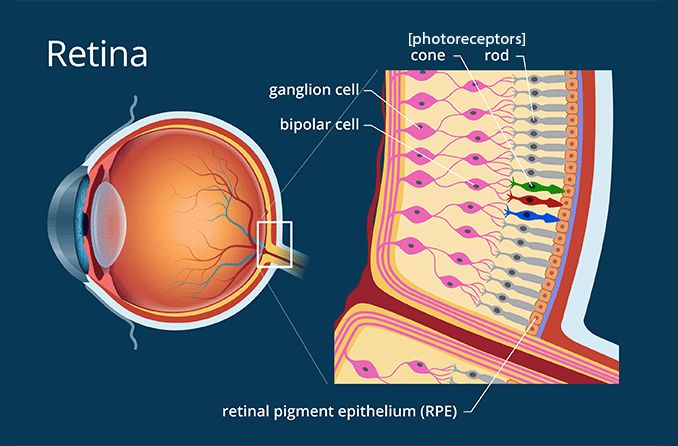
The phytochromes which perceive red 650-670nm and far-red 705-740nm lights the cryptochromes the phototropin and the F-Box. These specialized cells are called photoreceptors. The fundamental-and as yet imperfectly answered-question is how is this achieved at the molecular level. There are two kinds of photoreceptors. Stimulated by light energy. Photoreceptors are special cells in the eyes retina that are responsible for converting light into signals that are sent to the brain.
 Source: tr.pinterest.com
There are 2 types of photoreceptors in the. Rod cells are highly sensitive to light and function in nightvision whereas cone cells are capable of detecting a wide spectrum of light photons and are responsible for colour vision. Stimulated by light energy. While cone photoreceptors detect color through bright light rod photoreceptors are sensitive to low-light levels. Highly sensitive to minimal light allows us to see at night shapes and movement rhodopsin split into opsin and retinene in photon of lightopsin and retinene turn ATP into ADP and combine back to make rhodopsin.
 Source: pinterest.com
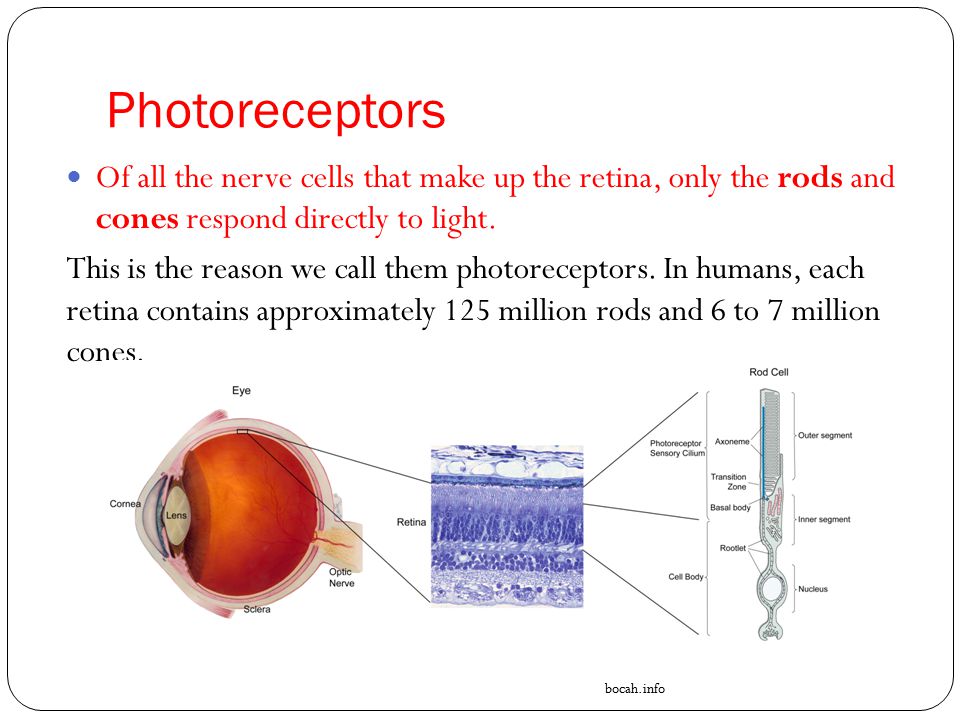
Signaling photoreceptors use the information contained in the absorption of a photon to modulate biological activity in plants and a wide range of organisms. The visual pigment consists of a protein called opsin and a chromophore derived from vitamin A known as retinal. The four types of general sensory receptors and the stimuli that excite them are nociceptors pain thermoreceptors temperature mechanoreceptors physical distortion and chemoreceptors chemical con- centration. Rods and cones are structurally compartmentalised. Rod cells are highly sensitive to light and function in nightvision whereas cone cells are capable of detecting a wide spectrum of light photons and are responsible for colour vision.
 Source: pinterest.com
There are two types of photoreceptors in the human retina rods and cones. They are responsible for dim-light vision. We adopt the perspective of biophysi. Photoreceptors are special cells in the eyes retina that are responsible for converting light into signals that are sent to the brain. Cone photoreceptors are morphologically and functionally distinct from rods and express several types of visual pigments or opsins whose spectral sensitivity varies based on the cones subtype.
 Source: pinterest.com
2 3 4 At variance with other proteins what is compelling in photoreceptors is a detailed knowledge of the chromophore local environment namely. Rods are responsible for vision at low light levels scotopic vision. The four types of general sensory receptors and the stimuli that excite them are nociceptors pain thermoreceptors temperature mechanoreceptors physical distortion and chemoreceptors chemical con- centration. We adopt the perspective of biophysi. Stimulated by light energy.
 Source: allaboutvision.com
The phytochromes which perceive red 650-670nm and far-red 705-740nm lights the cryptochromes the phototropin and the F-Box. Signaling photoreceptors use the information contained in the absorption of a photon to modulate biological activity in plants and a wide range of organisms. Cone photoreceptors and rod. What are the four types of sensory receptors for the general senses. Photoreceptors in the retina are classified into two groups named after their physical morphologies.
 Source: aao.org
The well-known retinal photoreceptors in all vertebrates are the rods and cones. Rods and cones are structurally compartmentalised. They do not mediate color vision and have a low spatial acuity. There are two types of photoreceptors in the human retina rods and cones. These cells function by sensing light andor color and delivering the message back to the brain through the optic nerve.
 Source: pinterest.com
What are 2 types of photoreceptors. There are two types of photoreceptors in the human retina rods and cones. Photoreceptors are special cells in the eyes retina that are responsible for converting light into signals that are sent to the brain. There are two types of photoreceptors in the human retina rods and cones. S-cones M-cones and L-cones see Chapter 12 Color vision and night vision.
 Source: slideplayer.com
Rods are responsible for vision at low light levels scotopic vision. 2 3 4 At variance with other proteins what is compelling in photoreceptors is a detailed knowledge of the chromophore local environment namely. Structure and function of plant photoreceptors Annu Rev Plant Biol. Photoreceptors are special cells in the eyes retina that are responsible for converting light into signals that are sent to the brain. What are the four types of sensory receptors for the general senses.
 Source: foundationsofvision.stanford.edu
In humans three classes of cones confer robust color vision. Cones are active at higher light levels photopic vision are capable of color vision and are responsible for high spatial acuity. Cone photoreceptors are morphologically and functionally distinct from rods and express several types of visual pigments or opsins whose spectral sensitivity varies based on the cones subtype. These properties reflect the fact that the rod and cone systems the receptors and their connections within the retina are specialized for. They act as a type of pupil protecting the rhabdom in bright conditions by absorbing light.
 Source: sk.pinterest.com
While cone photoreceptors detect color through bright light rod photoreceptors are sensitive to low-light levels. The well-known retinal photoreceptors in all vertebrates are the rods and cones. Cones are active at higher light levels photopic vision are capable of color vision and are responsible for high spatial acuity. Two types of photoreceptors reside in the retina. Tap card to see definition.
 Source: reasonandscience.catsboard.com
The phytochromes which perceive red 650-670nm and far-red 705-740nm lights the cryptochromes the phototropin and the F-Box. They do not mediate color vision and have a low spatial acuity. Detect photons filled with photopigments they change their conformation when struk by a photon. Rods cones and intrinsically photosensitive retinal ganglion cells. The four types of general sensory receptors and the stimuli that excite them are nociceptors pain thermoreceptors temperature mechanoreceptors physical distortion and chemoreceptors chemical con- centration.
Source: pinterest.com
The phytochromes which perceive red 650-670nm and far-red 705-740nm lights the cryptochromes the phototropin and the F-Box. Rod cells are highly sensitive to light and function in nightvision whereas cone cells are capable of detecting a wide spectrum of light photons and are responsible for colour vision. The well-known retinal photoreceptors in all vertebrates are the rods and cones. Cone photoreceptors and rod photoreceptors. Tap again to see term.
 Source: researchgate.net
These specialized cells are called photoreceptors. What are the two types of the photoreceptors of the eye give their uses. Blue-light receptors those that absorb blue. They consist of five. Rods are responsible for vision at low light levels scotopic vision.
 Source: researchgate.net
Vertebrate photoreceptors can respond to light by virtue of their containing a visual pigment embedded in the bilipid membranous discs that make up the outer segment. A photoreceptor usually com-prises a number of discrete protein items generally known as modules or domains every of which varieties a co-valentlyconnectedcompactlyfoldedportionof the sequence. Photoreceptors in the retina are classified into two groups named after their physical morphologies. Actually there are five types of photoreceptors in plants. Rods cones and intrinsically photosensitive retinal ganglion cells.
Source: researchgate.net
What are the four types of sensory receptors for the general senses. There are two types of photoreceptors. Rod cells are highly sensitive to light and function in nightvision whereas cone cells are capable of detecting a wide spectrum of light photons and are responsible for colour vision. Rods are responsible for vision at low light levels scotopic vision. The four types of general sensory receptors and the stimuli that excite them are nociceptors pain thermoreceptors temperature mechanoreceptors physical distortion and chemoreceptors chemical con- centration.
 Source: es.pinterest.com
They consist of five. The phytochromes which perceive red 650-670nm and far-red 705-740nm lights the cryptochromes the phototropin and the F-Box. They do not mediate color vision and have a low spatial acuity. They consist of five. Rods are extremely sensitive to light being able to detect and signal the absorption of a single photon.
 Source: pinterest.com
Rods are responsible for vision at low light levels scotopic vision. Rods cones and intrinsically photosensitive retinal ganglion cells. What are the two types of photoreceptors and their functions. These properties reflect the fact that the rod and cone systems the receptors and their connections within the retina are specialized for. Photoreceptors in the retina are classified into two groups named after their physical morphologies.
 Source: pinterest.com
The fundamental-and as yet imperfectly answered-question is how is this achieved at the molecular level. The vitamin A is manufactured from beta-carotene in the food we eat and the protein is. Vertebrate photoreceptors can respond to light by virtue of their containing a visual pigment embedded in the bilipid membranous discs that make up the outer segment. The four types of general sensory receptors and the stimuli that excite them are nociceptors pain thermoreceptors temperature mechanoreceptors physical distortion and chemoreceptors chemical con- centration. Blue-light receptors those that absorb blue.
This site is an open community for users to submit their favorite wallpapers on the internet, all images or pictures in this website are for personal wallpaper use only, it is stricly prohibited to use this wallpaper for commercial purposes, if you are the author and find this image is shared without your permission, please kindly raise a DMCA report to Us.
If you find this site beneficial, please support us by sharing this posts to your preference social media accounts like Facebook, Instagram and so on or you can also bookmark this blog page with the title what are the types of photoreceptors and their functions by using Ctrl + D for devices a laptop with a Windows operating system or Command + D for laptops with an Apple operating system. If you use a smartphone, you can also use the drawer menu of the browser you are using. Whether it’s a Windows, Mac, iOS or Android operating system, you will still be able to bookmark this website.